
Schedule regular updates of your data
A scheduled update keeps a dataset current without you doing anything. At the time you choose, Koordinates checks the data source the dataset was imported from. If the source data has changed, Koordinates imports it and publishes a new version of the dataset. If it hasn’t changed, nothing happens.
Before you start
Section titled “Before you start”- Your plan must include scheduled updates. They’re available on Team Cloud (up to 10 datasets), Business Cloud and Enterprise plans. See Features by plan. If your plan doesn’t include them, the dataset has no Scheduled Updates tab.
- The dataset must come from a connected data source. Only datasets made from a single connected data source can have scheduled updates. Data you uploaded as files can’t be scheduled. If a dataset can’t have a schedule, the Scheduled Updates tab says: “This dataset is not compatible with scheduled updates.” Sets and Kart datasets don’t have the tab, and neither does a dataset that hasn’t been published yet.
- Use a source that is reliably available. A scheduled update can only pick up changes if Koordinates can reach the source at the scheduled time. For the types of source you can connect, see Introducing supported data sources. To connect a source that’s inside your own network, see Introducing the Data Gateway.
Set up a scheduled update
Section titled “Set up a scheduled update”-
Open the dataset’s Scheduled Updates tab
Select Manage in the navigation menu to open the Data Manager, then open the dataset and select the Scheduled Updates tab.
-
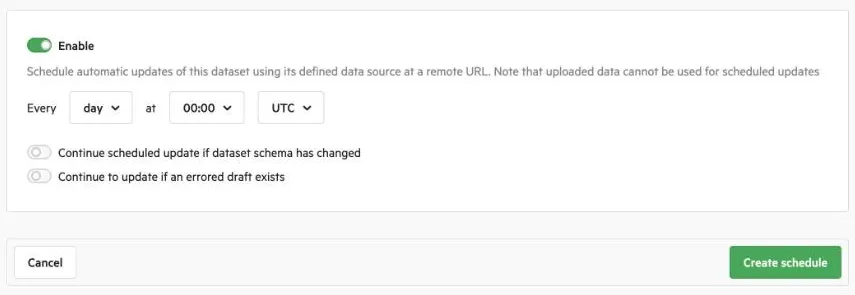
Turn on Enable and choose when to update
Turn on Enable. Then choose how often the update runs: every day, week or month. For a weekly schedule, also choose the day of the week. For a monthly schedule, also choose the day of the month. Then choose the time and the timezone.
Times are whole hours, such as 00:00 or 14:00. If you choose a day of the month that some months don’t have, such as the 31st, the tab warns you which months the update won’t run in.
-
Choose what happens when things go wrong (optional)
Two more options appear once Enable is on. Both are off by default.
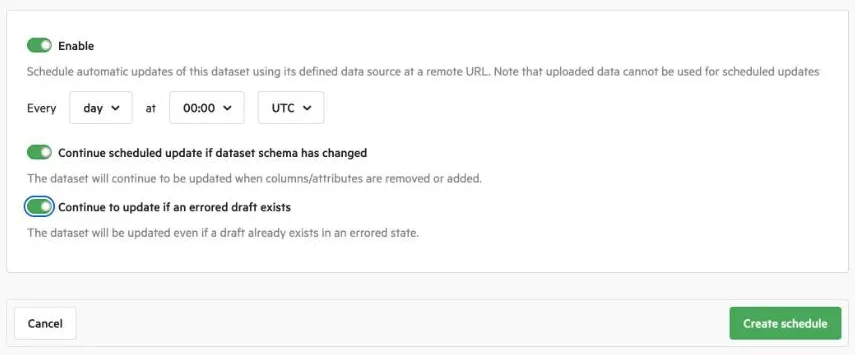
- Continue scheduled update if dataset schema has changed. By default, a scheduled update doesn’t go ahead if columns have been added or removed in the source. Turn this on to update the dataset anyway.
- Continue to update if an errored draft exists. By default, a scheduled update doesn’t run while the dataset has a draft in an errored state, for example after an earlier update failed. Turn this on and the update goes ahead anyway: the errored draft is discarded and the update continues. See Manage data updates and QA using drafts.
-
Create the schedule
Select Create schedule. To change a schedule later, change the settings and select Save. Select Cancel to discard changes you haven’t saved. To stop scheduled updates, turn Enable off and save.
If the tab shows Complex schedule currently configured, the dataset has a schedule that the tab can’t edit, such as one set through the API. Select Clear existing schedule to replace it with a new one.
What happens at the scheduled time
Section titled “What happens at the scheduled time”- Koordinates checks the source files or tables that this dataset was made from. It doesn’t scan the whole source, and it doesn’t look for new datasets to import.
- If those files or tables have changed since the dataset was last updated, Koordinates imports the new data and publishes it as a new version of the dataset.
- If they haven’t changed, nothing happens. The dataset stays as it is.
The update also doesn’t go ahead if the source data no longer fits the dataset. For example, the projection or geometry type has changed, the source can’t be found, or columns were added or removed and Continue scheduled update if dataset schema has changed is off. In that case the dataset keeps its current published version.
If a dataset didn’t update when you expected, see Troubleshoot an import or update that is slow, stuck or failed.
Use the API
Section titled “Use the API”Scheduled updates can also be set up and changed using the API. See Turn on scheduled updates, or the API documentation at https://apidocs.koordinates.com/.